Operations software for multi-location businesses
You are not running twelve locations. You are running one, and hearing about eleven.
SOP records what was actually done at every site: in the time window, at the site, in order, with photographs taken in the moment. Checklists, tickets on a clock, cash, stock, equipment, attendance and network analytics in one record per location per day. We build it, deploy it on infrastructure in your name, and you own the instance.
See the live systemA working walkthrough with the person who built it. Bring your location count if you have it. If you don't, come anyway.
Read the transcript
Can you prove what happened at location seven this morning?
WhatsApp groups.
Paper checklists.
Spreadsheets.
None of it is evidence.
SOP is one operating system for every location.
A live cockpit shows every location at a glance — open, compliant, or behind — for all sites at once, without a single phone call.
Ticking the box isn't enough.
Checklists are time-window locked, forced sequential, camera-only, GPS-verified, and signed off by the location owner.
Issues escalate themselves.
Every ticket runs a 48-hour turnaround clock, with a warning at 75 per cent and an automatic breach flag.
Cash is reconciled the same day, with live variance against expected takings and expenses captured at the counter.
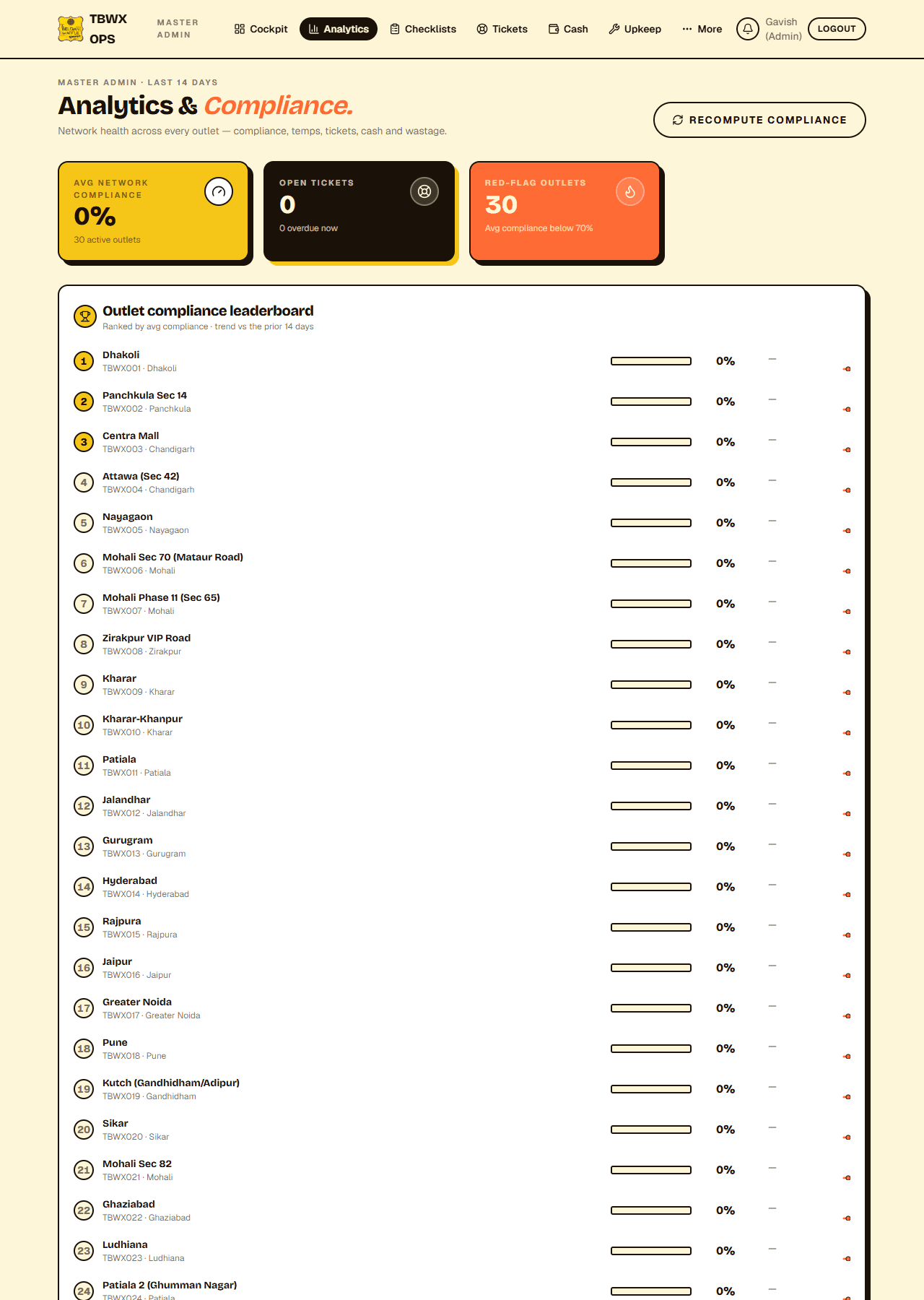
Compliance becomes something you can rank: location leaderboards, trends over time, and missed checklists detected without anyone chasing.
Equipment is serviced on a schedule rather than after a breakdown, with a register and service history per site.
It is deployed as a private instance — your server, your data, your branding — not another seat licence you pay for forever.
We run our own 39-location business on it, every day.
See it at nofluff.pro.
In daily production use across 39 locations of The Belgian Waffle Xpress, a food and beverage franchise founded and run by NoFluff's founder. That is the only deployment we have. We say so here, and we say it again below.
Written for owners and ops directors running between three and fifty sites. At three, a spreadsheet is sometimes still enough, and we will tell you that on the call rather than after the contract.
The problem
The gap between what you asked for and what you can prove
Three locations, you can hold it together with attention. Twelve, and attention runs out. The failure is not that standards drop. It is that you stop being able to prove they didn't.
The opening checklist gets filled in at nine at night, for the whole day, in one sitting. The same photo of a clean prep station arrives three weeks running. A manager signs off a temperature nobody read. A broken freezer is mentioned in a group chat at eleven, scrolls past twelve other messages, and is remembered again when it fails completely.
So you drive out. You drop in unannounced, and the site you visit is immaculate, because they saw your car. You hire an area manager whose job is to be your eyes, and now you're trusting their word instead of the staff's word. You build a spreadsheet, and someone stops updating it in month two.
None of this is malice. It's a system that asks people to record work at no cost to recording it falsely. When the record costs nothing, the record means nothing.
And the worst part is what you never see. Nobody messages the group to say "I skipped the fridge check." You read the messages that arrived and take that as everything being fine. An absent message looks exactly like a quiet day.
Anti-gaming
How we made faking it harder than doing it
Every control below is live in production today. None of it is roadmap.
Time-window locks
The opening checklist opens when the location opens and closes when the window closes. It can't be completed early, and it can't be back-filled at midnight. A task not done in its window is recorded as a miss, not left as pending.
Forced sequential steps
Step four doesn't open until step three is done. Nobody cherry-picks the easy items and leaves the awkward ones for later or never. The sequence is the process.
Camera-only capture
Photos are taken through the app, in the moment. There is no gallery upload path, so last week's picture has no route in, and files are validated at byte level so a renamed file doesn't pass as an image.
GPS geofence
Completion is checked against the site boundary at the moment it happens, and a mismatch is recorded rather than silently accepted.
Owner sign-off
Staff complete. The location owner reviews and signs. Two actions, two names, both logged.
Flag an issue on any step
Any step can be flagged instead of falsely ticked. If the only options are tick and get in trouble, people tick. The flag lowers that location's compliance score, because the score describes the state of the location, not the mood of the person filling in the form.
Audit log and device revoke
Who did what, when, from which device. Sessions can be cut off from a phone that walked out with an ex-employee.
The honest limit
These do not make dishonesty impossible. Nothing does. GPS can be spoofed and a camera can photograph a screen. What the controls remove is the cheap workaround. Anyone determined to fake it now has to stand at the location, at the right time, with the camera out. At that point they may as well do the job.
What it does
One record per location, per day
Daily execution
Role-based checklists for opening, closing, shift routines and periodic tasks, with the controls above. Per-step issue flagging. Shift handover, so the closing team's knowledge reaches the opening team instead of evaporating.
Issues with a clock on them
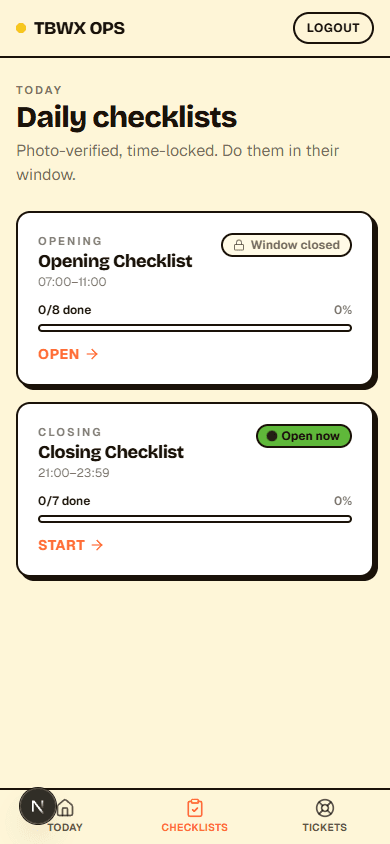
Tickets run a 48-hour turnaround engine. A warning fires at 75% of the window. A breach escalates to the level above and is recorded. The clock pauses when a ticket is genuinely on hold, so nobody is punished for waiting on a supplier.
Money and stock
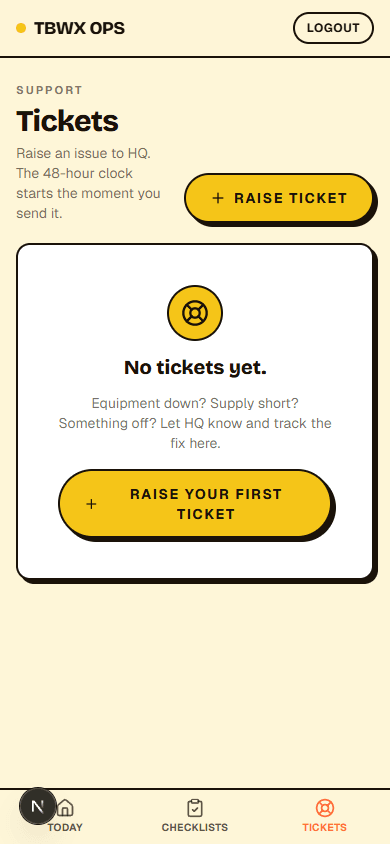
Cash reconciliation with live variance against expected, expenses captured at the location, inventory par-counts and wastage logging. A cash variance found on the day is a conversation. The same variance found at month end is a write-off.
Equipment
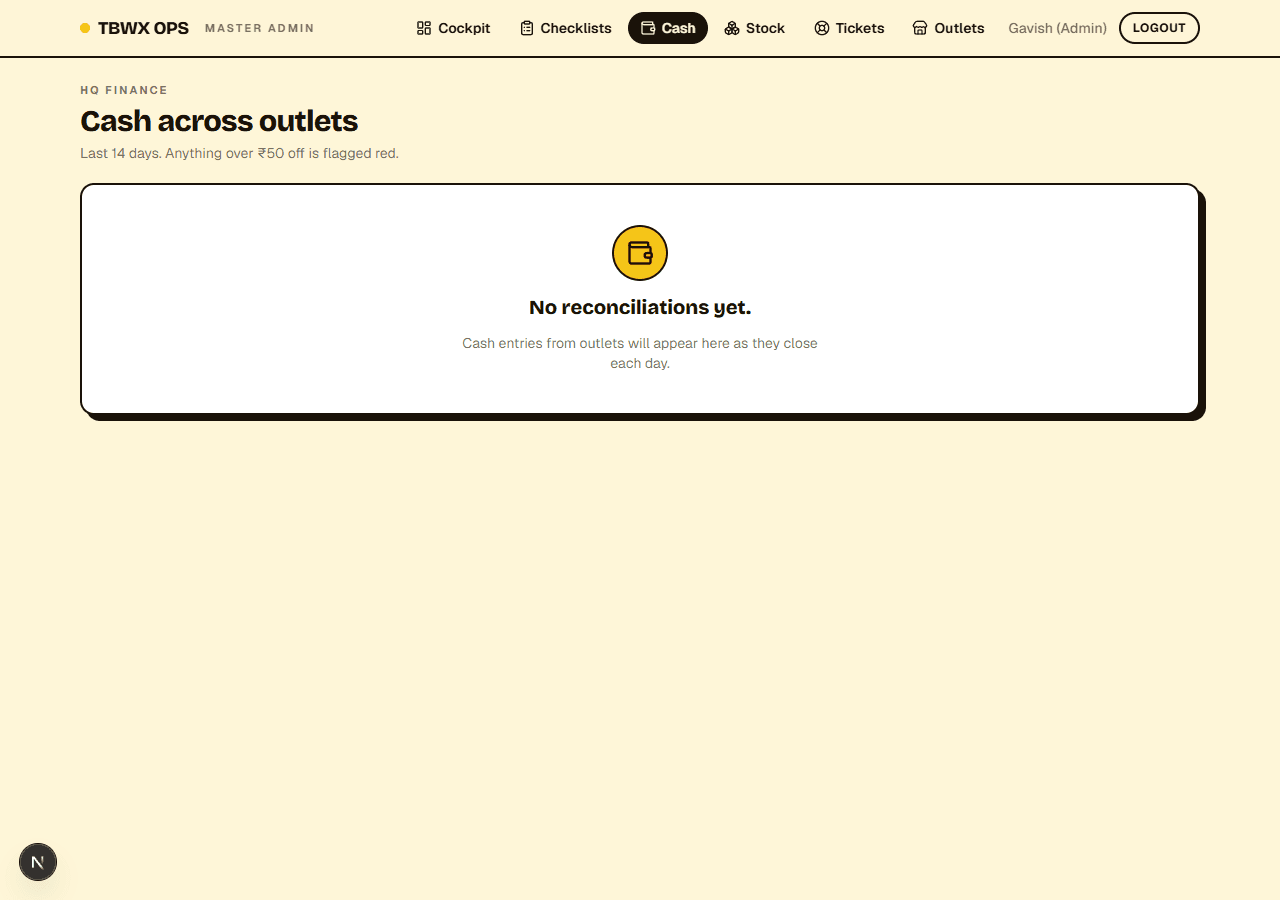
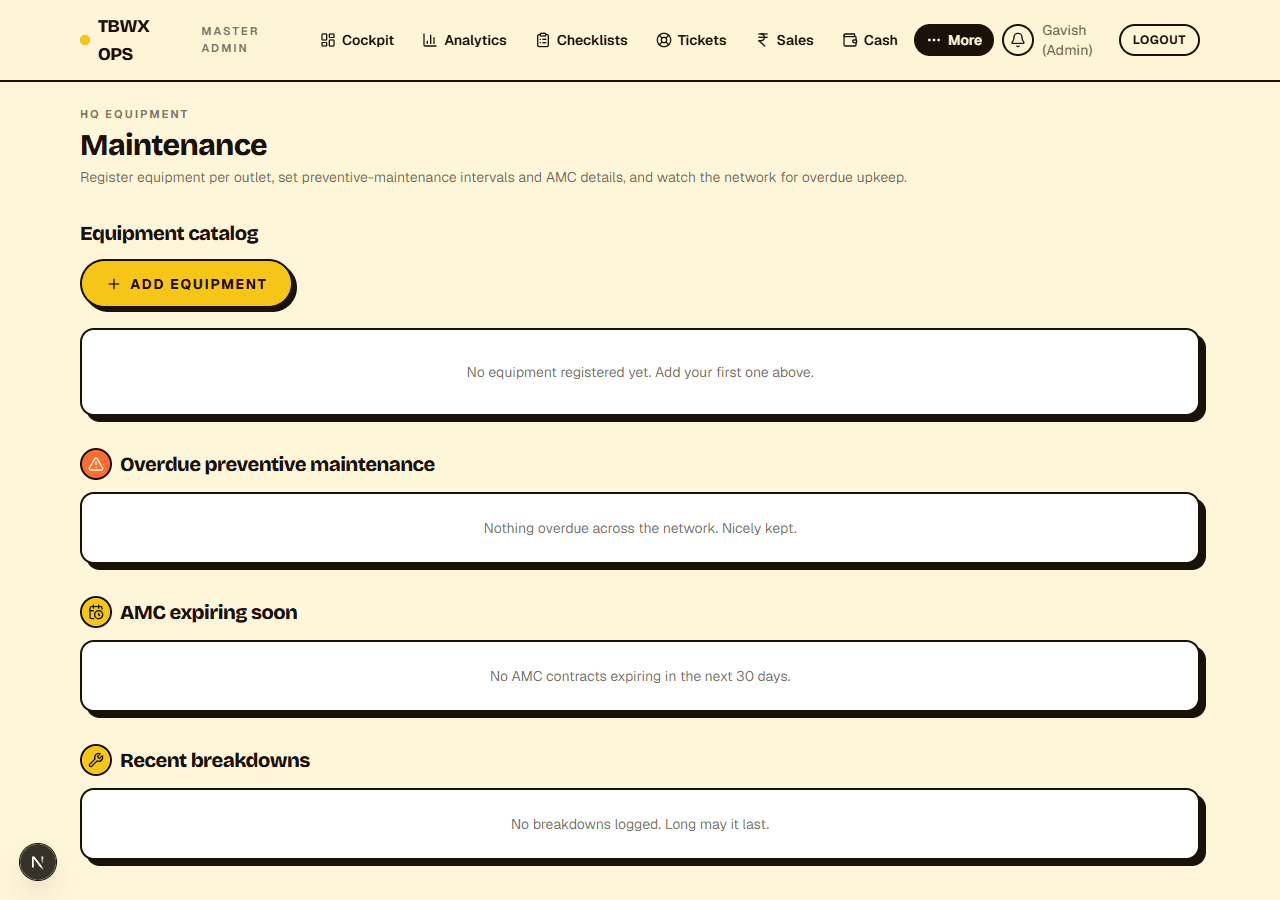
Equipment register per location, preventive maintenance with PM-due tracking, and service-contract tracking so cover lapses are visible before the breakdown. Planned maintenance runs on your calendar at your rate. Failure runs on someone else's.
People
Clock in and clock out with overtime, PDF attendance reports, and separate head-office attendance kept apart from floor records.
What head office sees
Network KPIs across every location, a ranked leaderboard, trends over time, and missed-checklist detection, which reports the absence of a submission instead of letting silence look like compliance. Health and food-safety CSV export for inspection requests.
Four roles, four views
Master admin, location owner, floor staff, head office. Each sees what the job requires.
On the floor
A progressive web app that installs on the phone staff already carry. Offline-tolerant and multi-language.
Ownership
You own the instance, not a login to someone else's
Most operations software is rented. You get an account inside a product thousands of other businesses share. The vendor decides the roadmap, holds the data, and decides what the product becomes next year. SOP is deployed as a private instance: your server, your database, your branding, your subdomain.
Your data is in your database
Photos, cash figures, attendance records, six months of compliance history. Export is a query, not a support ticket, and there's no platform standing between you and the record of your own business.
The process bends to you
A rented product gives you the checklist structure it decided on, because it has to serve everyone. If your closing procedure has fourteen steps in a specific order, your instance has fourteen steps in that order, including the awkward ones that don't fit a template.
Change is a scoping conversation
The code runs on your instance. Nothing waits behind ten thousand other customers, and nobody sunsets a feature you built a process around.
Growth stops being a procurement event
Location 12 opening isn't a purchase order, and four seasonal hires isn't a licensing decision. It does add hosting and support load, and how that's handled is written into the engagement rather than left vague on a web page.
Leaving is not a hostage situation
The instance is on your infrastructure with your data. If the relationship ends, it keeps running. What matters more than that sentence is the paperwork behind it: whose name the hosting account is in, what licence the software is under, and what happens to updates. Ask for those terms on the first call.
Where a rented seat is the better buy
Some rented tools do checklists genuinely well. If one of them fits the way your locations actually run, and you would rather never think about infrastructure, buy it. That's a legitimate answer and we'll say so on the call.
A projection, labelled as one
Per-location, per-seat subscriptions rise as you add sites and staff, for as long as you keep trading. An owned instance doesn't scale on that axis. That is arithmetic about how subscription pricing behaves, not a saving we have measured on your books. Bring your current stack to the call and we'll do the sum with your real figures.
Security
Who can see what
Locations are separated
One location's account cannot read another location's data. We test this on every release and we will run the test in front of you. It is internal testing, not an independent audit, and we would rather tell you that than let the word "audited" do work it hasn't earned.
Access is revocable
Device sessions can be cut off. Every action is in the audit log with a name, a time and a device.
Accounts are hardened
Argon2id password hashing, per-account lockout after failed attempts, per-IP rate limiting, CSP headers, and byte-level validation on every uploaded file.
Certifications, plainly
We do not hold SOC 2 or ISO 27001. If your procurement process requires either, say so on the first call and we'll give you a straight answer about whether we can meet it rather than discovering it in month three.
Employee data
The system records staff locations, working hours and photographs of work in progress. That is employee data, and you are the one accountable for it. Before go-live we walk through what is captured, where it is stored, who can see it and how long it is kept, and you decide.
Records and regulators
SOP records evidence. It is not certified against any regulatory regime. Whether the evidence it produces satisfies your inspector is your call and your advisor's.
Industry agnostic
The problem is multi-location, not multi-restaurant
Underneath the food-specific wording, the machinery is generic. A recurring task. A time window. A place. Evidence. Someone accountable for signing it off. An escalation path when something breaks. Money counted at a counter, stock that walks, equipment that fails, and hours that get paid.
Restaurant groups and QSR chains
Opening and closing lines, cleaning cycles, cash-up variance, wastage, inspection exports.
Gyms and fitness studios
Floor sweeps, changing-room standards with photo proof, equipment servicing schedules, member-reported faults as tickets.
Salons, spas and barbershops
Station hygiene, product par counts, close-down cash, handover between shifts.
Retail chains
Store-open standards, merchandising checks with photo proof, stockroom counts, till variance, maintenance across the estate.
Multi-site service businesses
Site routines proven by geofence rather than by timesheet, equipment registers, franchisee compliance scoring.
Clinic and practice groups
Room turnover, opening standards, equipment servicing, staff hours across sites. Anything touching patient records or clinical governance is outside what this system claims.
We have deployed in food and beverage. We have not deployed in any of the others. That list is where we believe the same mechanics apply, and the honest test is thirty minutes on a call mapping your two highest-risk routines and seeing whether they build cleanly. If they don't, you'll know inside that call.
The engagement
What actually happens after the call
Mapping
We take your real procedures, in your words, and turn them into checklists with the locks, photo requirements and sign-off chain set to your rules.
One location first
We deploy your instance, configure it, and run a single pilot site until the routine holds and the staff stop needing to be told.
Rollout
The remaining locations, in the order you choose, with the checklist library already proven at the pilot.
Running it
Hosting, patching, backups and support are scoped in the engagement, in writing, with the boundary between what we own and what you own stated explicitly rather than assumed.
Why there is no price on this page
Because the work is scoped, not shelved, and any number here would be wrong for most of the people reading it. What we won't do is discover your budget and price to it. Ask on the first call and you'll get the range and what moves it.
On demand
Built, but not part of the core offer
These exist in the platform and can be switched on or adapted for your instance. They are listed separately because they are scoped separately.
Invoicing, ledger and payroll
Running in production, but built to Indian tax rules for the original deployment. For a US operation this needs adapting to your jurisdiction, and anything statutory needs your accountant's sign-off.
Browser push notifications
The delivery pipeline is built; enabling it is a configuration step per instance.
Offline sync
The app is offline-tolerant today. Full background sync for long stretches without signal is a scoped extension.
Additional languages
The interface already runs multi-language. Adding one is a translation and review pass, not a rebuild.
Integrations
POS, payroll and accounting systems, connected to your instance rather than waiting on a shared roadmap.
White-label domain and branding
Your subdomain, your logo, your palette, so staff see your brand and not ours.
Due diligence
Questions we'd ask if we were you
Bring this list to the call. If any answer is vague, push.
- —Who edits a checklist on day 400, us or you, and how long does a change take?
- —What exactly happens when a phone goes offline mid-checklist, and when the signal returns?
- —How is the compliance score calculated, and what does a flag cost compared with a miss?
- —Who answers at six in the morning when a location can't open its checklist, and how fast?
- —What is in the contract about the hosting account, the software licence, continuity and exit?
- —What is backed up, how often, and when was a restore last tested?
- —Which languages are already supported, and what does adding one involve?
- —What is not built, and what would we be paying to have built?
FAQ
The objections worth raising
You've deployed this once. Why should we go first?+
Because one deployment is a narrow base of evidence and a deep one. Thirty-nine locations, in daily production use by floor staff, location owners and head office, across sites run by different owners, long enough that the soft design decisions have already been attacked by people looking for shortcuts. The controls on this page are what survived that. There's a second thing worth knowing: the franchise it runs is our founder's own business. When it breaks, our own revenue is the one that suffers. That alignment doesn't exist when a supplier sells you software they never have to live with. We'd rather tell you that than invent a client list.
Our staff will find a way around it. They always do.+
Ours tried. That's why the controls are shaped the way they are. There's no gallery upload, so old photos have no route in. There's no back-filling, because the window closes. There's no remote completion, because location is checked at the moment of submission. There's no silent sign-off, because the owner signs separately and both actions are logged. And there's a release valve, deliberately: any step can be flagged in one tap, so reporting the truth is easier than beating the controls. No control is unbeatable. These raise the cost of faking a pass above the cost of doing the job.
We already pay for a checklist tool. Why move?+
If checklists are your only gap, keep it. That's a real answer and we'll give it to you on the call. Count what it doesn't do. It doesn't put a clock on the problems the checklist uncovers, with a pause when you're waiting on a supplier and an escalation when the clock runs out. It doesn't reconcile your till. It doesn't know when your equipment was last serviced or when cover expires. It doesn't run attendance. And whatever it does, you're renting a seat inside a structure someone else designed.
We have no IT department. Who runs the server?+
We do. NoFluff deploys the instance, configures it to your operation, moves you off the spreadsheets, and maintains it. Ownership here means the server, the database and the data are in your name, not that you're handed a zip file and wished luck. The inverse is worth saying out loud: a private instance means patching, backups and uptime are someone's job forever. That someone is us, under the terms in the engagement.
What happens to our data, and what if we part ways?+
The instance is yours from day one. It runs on your infrastructure, under your branding, holding your data. If the relationship ends, the system keeps running, and there's no export request to file because we were never holding it. What makes that real is the contract, not this paragraph. Licence terms, hosting credentials, documentation, continuity and notice period are agreed before you commit, in writing.
Why is there no price on this page?+
Because the work is scoped, not shelved, and any number here would be wrong for most of the people reading it. What we won't do is discover your budget and price to it. Ask on the first call and you'll get the range and what moves it.
See it work, then decide
You already know which location worries you. You know whose reports you half-believe, and which check you assume is being done and have never once seen evidence of.
Book the call. We'll open a working instance, with names, figures and photographs masked, and show you an opening checklist being completed under the time lock, the geofence and the camera control. Then we'll take your highest-risk recurring routine and build it in front of you, with your steps, your roles and your escalation rules.
You'll leave knowing what a deployment for your business would involve, what we'd configure first, and where the honest limits are. If it's a bad fit, we'll say so on the call. A failed custom implementation costs us months of capacity. A failed subscription costs you a month. We have more reason than you do to get this right at the start.
No slide deck. A working instance, your questions, and a straight answer on fit.
Deployed as a private instance: your server, your database, your branding. Deployment reference as of August 2026: 39 locations of The Belgian Waffle Xpress, a food and beverage franchise founded and run by NoFluff's founder, and the only production deployment of SOP to date.